| Genre: | Drama, History, Romance |
| Year: | 1935 |
| MPAA Rated: | NR |
| Viewer Rating: | |
| IMDB Rating: | 7.6 |
| Director: | Richard Boleslawski |
| Actors: | Fredric March, Charles Laughton, Cedric Hardwicke |
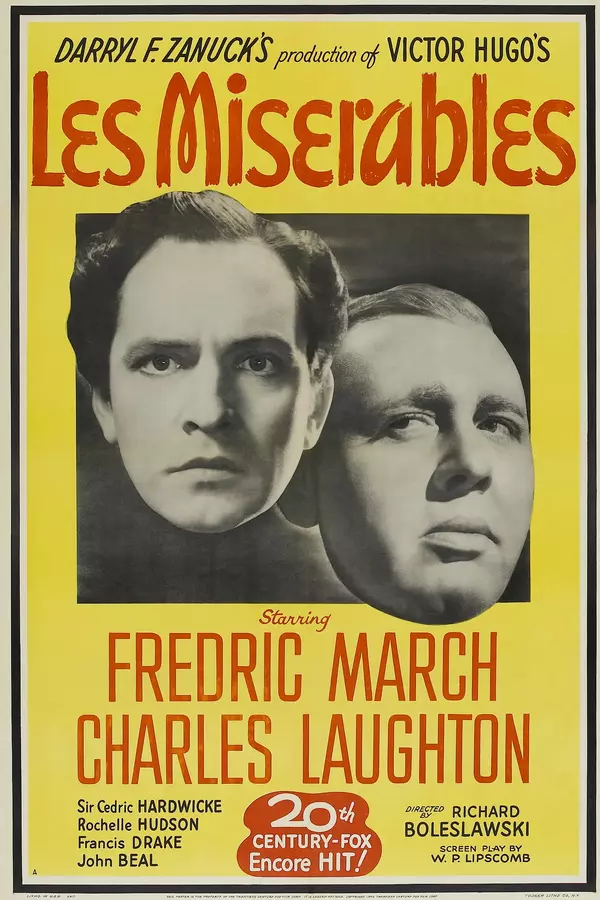
Directed by Richard Boleslawski, Les Misérables (1935) is a magnificent, deeply moving, and critically acclaimed pre-Code Hollywood adaptation of Victor Hugo’s monumental literary masterpiece. Set in 19th-century France, the story chronicles the agonizing, decades-long pursuit of Jean Valjean (Fredric March), a destitute peasant who was sentenced to five brutal years in the galleys of the French penal system simply for stealing a loaf of bread to feed his starving family. Following nearly two decades of imprisonment due to repeated escape attempts and parole violations, Valjean finally achieves his freedom under a harsh ticket-of-leave, only to find himself embittered, shunned, and forced to sleep on the streets with no hope for honest work.
Salvation arrives when a compassionate Bishop takes Valjean in, showing him radical forgiveness and mercy even after Valjean steals his silver candlesticks. Deeply transformed by this act of grace, Valjean breaks his parole, assumes a new identity, and dedicates his life to quiet charity, eventually becoming a wealthy factory owner and a beloved mayor. However, his hard-won peace is relentlessly threatened by Inspector Javert (Charles Laughton), an unyielding, fanatically righteous lawman who has made it his life’s mission to hunt Valjean down and return him to justice. As their paths cross against the backdrop of political unrest and revolutionary fervor in Paris, the film builds toward a soaring, emotionally devastating meditation on justice, mercy, and redemption.
What Makes This Movie Special
- Legendary Lead Performances: Fredric March and Charles Laughton deliver towering, career-best dramatic performances, creating an unforgettable psychological chess match between a man seeking redemption and a man obsessed with rigid law.
- A Prestige Pre-Code Adaptation: Produced during Hollywood’s rich pre-Code era before strict censorship fully took hold, the film retains a raw, unvarnished grit and emotional darkness that makes the human suffering and injustice feel deeply palpable.
- Historic Academy Award Recognition: The film achieved massive critical acclaim upon its release, earning prestigious Academy Award nominations for Best Picture, Best Assistant Director, and Best Film Editing.
- Fidelity to Victor Hugo’s Themes: While condensing the massive thousand-page novel into a feature-length runtime, the screenplay successfully captures Hugo’s central philosophical crusade against institutional cruelty and societal indifference toward the poor.
Why You May Like This Movie
- You love classic, golden-age Hollywood historical dramas featuring powerhouse dramatic acting masterclasses by legendary silver-screen icons.
- You appreciate timeless literary adaptations that explore profound moral themes like grace, justice, redemption, and human empathy.
- You enjoy intense cat-and-mouse character dynamics driven by ideological opposition and deeply emotional confrontations.
- You seek out overlooked, premier pre-Code cinematic masterpieces that set the gold standard for dramatic storytelling in early sound cinema.
Fun Facts
- Charles Laughton was so committed to capturing Inspector Javert’s cold, rigid posture and relentless obsession that he studied historical law enforcement accounts and intentionally rehearsed separate from the rest of the cast to maintain his isolated, intimidating demeanor.
- Fredric March performed many of his own physically demanding stunts during the grueling, muddy prison galley sequences and the chaotic Parisian barricade scenes, earning widespread admiration from the crew.
- Director Richard Boleslawski was a renowned disciple of the Moscow Art Theatre training methods, encouraging his lead actors to dive deep into psychological motivation rather than relying on standard silent-era theatrical melodramatic acting tropes.
- The film’s magnificent musical score, composed by Alfred Newman, set a new standard for atmospheric orchestral underscoring in 1930s cinema, seamlessly weaving recurring leitmotifs for Valjean and Javert.